If you ask me what my number one tool for managing stress is, I won’t say breathwork. I won’t say cold exposure. I won’t say the Zen Swing, even though I love that thing. I’ll tell you the same thing every time: find ten days of your life, turn off your phone, and sit in complete silence.
That’s Vipassana meditation. And if you’ve never heard of it, or you’ve heard the word and assumed it’s just another meditation app with a new name, this post is for you.
The Short Version
Vipassana is one of the oldest meditation techniques in the world. It’s not a religion, even though it comes out of a Buddhist lineage. It’s not a relaxation technique, even though people walk out of it calmer than they’ve ever been. It’s a method for observing your own body and mind closely enough that you stop reacting to everything that happens to you.
The word itself means “to see things as they really are.” Not as you wish they were. Not as your stress, your habits, or your ego want them to be. As they exist, moment to moment, inside your own body, not as your stress or your habits color them.
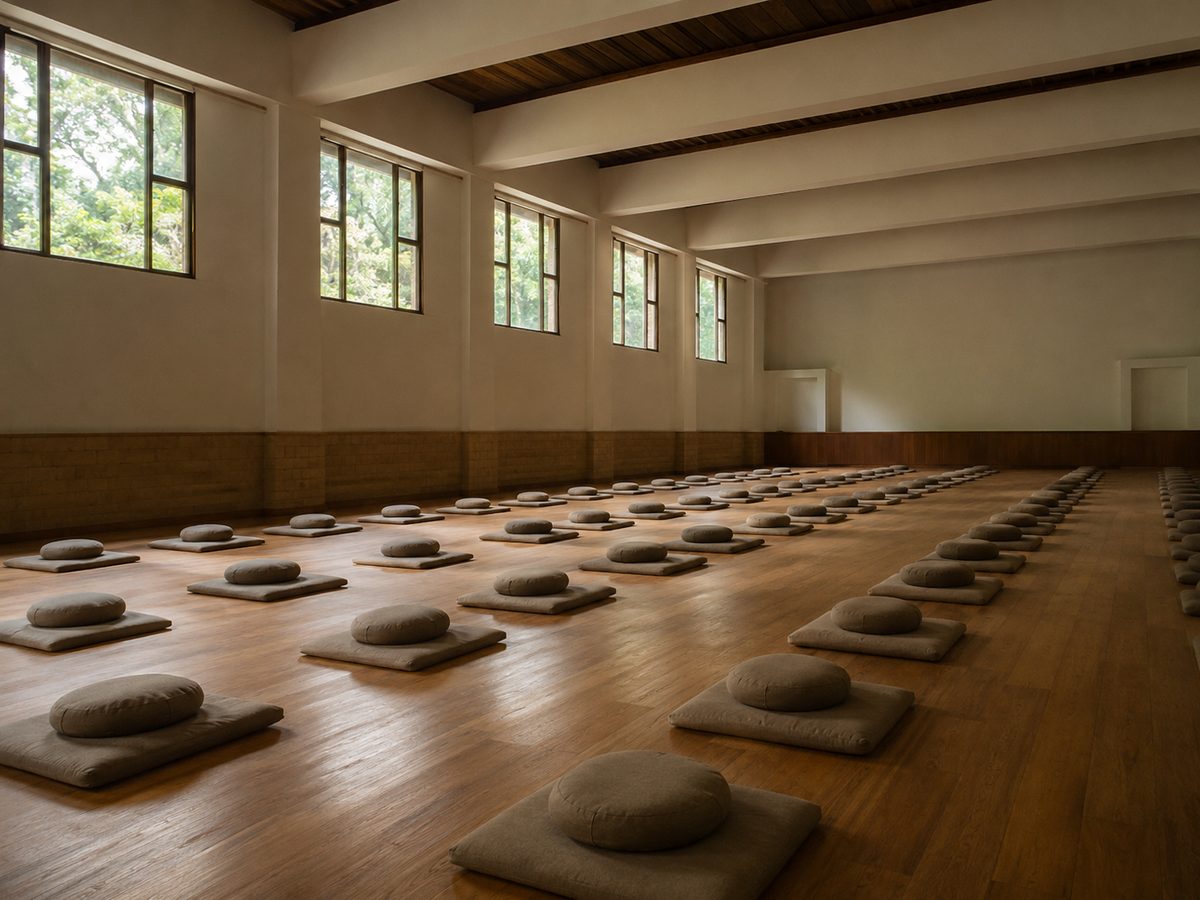
Most people encounter it through a specific format: a ten-day residential course, taught in silence, with no phone, no books, no writing, no eye contact, and no talking. You show up, you hand over your phone and your car keys, and for ten days you sit.
I know how that sounds. I thought the same thing the first time someone told me about it. Ten days of sitting still sounded like a punishment, not a practice. It’s the opposite. It’s one of the most useful things I’ve ever done for my nervous system, and it’s shaped a huge part of what I teach now, from the Silent Sits inside The Real Ones to the breathwork phases inside Breath Is Life.
Where Vipassana Comes From
Vipassana is old. Older than almost anything else in the wellness space right now. The technique traces back over 2,500 years, taught as a universal method for the mind, not tied to any particular religion or belief system, even though it developed inside a Buddhist tradition.
The version most people practice today, the ten-day silent retreat format, was revived and spread worldwide by a teacher named S.N. Goenka, starting in the 1970s. Goenka learned the technique in Burma and brought it back to India, then eventually the rest of the world. Centers now exist on nearly every continent, and the courses are taught the same way everywhere: same schedule, same instructions, same silence.
Here’s the part I find most interesting. These centers are almost entirely run on donations. You don’t pay to take the course. At the end, if you found it valuable, you can donate to help the next person take it for free. There’s no marketing funnel, no upsell, no premium tier. It’s one of the only wellness practices left that isn’t trying to sell you anything.
That alone made me trust it more than half the programs out there, mine included. When something has survived 2,500 years and still refuses to monetize itself, it’s probably not a fad.
What Happens in Ten Days
People imagine sitting cross-legged for ten days straight, and while there’s a lot of sitting, the structure is more specific than that.
The first three and a half days aren’t Vipassana at all. They’re a practice called Anapana, which just means breath awareness. You sit and observe your natural breath, nothing else. Not slow breathing, not deep breathing, not a pattern. Just watching the breath as it already is, at the nostrils, in and out.
This part matters more than people give it credit for. Before you can observe anything subtle in the body, you need a mind steady enough to pay attention in the first place. Three and a half days of pure breath awareness is what builds that steadiness. If you’ve ever tried to meditate for even five minutes and found your mind jumping to your inbox, your ex, or what you’re making for dinner, you already know why this step exists.
If that Anapana breathing sounds familiar, it should. It’s one of the core practices I teach inside Breath Is Life, in the third phase, where we work on staying grounded under real pressure. I didn’t invent that connection. I borrowed it directly from what I learned on my own Vipassana courses, because it works.
Once the mind has settled, the actual Vipassana technique begins. You systematically move your attention through the body, part by part, observing whatever sensation is present, without reacting to it. Itching, heat, tension, numbness, pain, pleasure, whatever shows up. The instruction is always the same: notice it, and don’t react.
That last part is the entire practice. Not the noticing. The not reacting.
Why the Not Reacting Part Is the Whole Point
Here’s what nobody tells you about stress before you sit with it directly: most of what makes stress unbearable isn’t the stressor itself. It’s your reaction to it. And that reaction runs on autopilot, every single time, unless you’ve trained yourself to notice the gap between the sensation and the response.
An itch shows up on your leg during hour four of sitting. Your first instinct is to scratch it immediately. Vipassana asks you to notice the itch, notice the urge to scratch, and just observe both without acting. Not because scratching is bad. Because in that pause, you’re training the exact skill that determines how you handle everything else in your life. A rude email. A missed flight. A hard conversation with someone you love.
Every uncomfortable sensation in the body becomes a small, low-stakes rehearsal for every uncomfortable moment in life. You’re not learning to suppress the itch. You’re learning that you don’t have to react to every single thing that happens to you the instant it happens. That gap between stimulus and response is where your actual freedom lives.
I’ve said this to people in Fit and Free more times than I can count: your testosterone doesn’t come out to play when your stress hormones are elevated. Your nervous system can’t build, repair, or produce when it’s stuck reacting to everything around it. Vipassana is the most direct training I’ve found for getting out of that reactive loop.
The Schedule Is Brutal, On Purpose
A typical day on a Vipassana course starts at 4:00 a.m. with a bell. You’re in the meditation hall by 4:30. Group sits happen throughout the day, adding up to roughly ten hours of meditation, broken into blocks, with breaks for two simple vegetarian meals and rest. Lights out by 9:30 p.m. Same thing, every day, for ten days.
No talking. Not to the other students, not to the teachers except during short designated question times, not even eye contact if you can help it. This is called Noble Silence, and it’s not there to make the experience harder for no reason. It removes every social distraction that normally lets you avoid sitting with yourself. No small talk to hide in. No group energy to borrow. Just you, your breath, and whatever comes up.
I won’t pretend it’s easy. Somewhere around day three or four, most people hit a wall. The mind gets loud. Old memories surface, sometimes ones you haven’t thought about in years. Physical discomfort peaks. This is normal, and it’s a sign the practice is working, not a sign something’s wrong. The teachers call it “old sankharas” surfacing, old mental and emotional patterns that get stirred up and released as the mind settles enough to notice them.
By day seven or eight, something shifts. The sits that felt impossible on day two start to feel completely different. Not easy, but different. Calmer. More spacious. That shift is the whole reason people keep going back.
Why I Swear By It, Specifically
I’ve done more wellness practices than I can list on one page. Cold plunges, fasting protocols, breathwork courses, plant medicine ceremonies, every biohack that’s crossed my desk in the last twenty years. Vipassana is the one I keep coming back to, and here’s why, in plain terms.
It’s free of gimmicks. No app subscription, no wearable, no supplement stack required. Just you and your own attention. In an industry that’s constantly trying to sell you the next tool, that’s rare, and it’s part of why I trust it.
It works on the root, not the symptom. Most stress management tools help you cope with stress after it’s already showing up in your body. Vipassana trains the mechanism that determines whether something becomes stressful in the first place. That’s a different level of intervention, and it’s why the results last longer than a good workout or a great meal.
It’s the same practice everywhere. No matter which center you go to, in any country, you get the exact same instructions. That consistency told me something. This isn’t one teacher’s opinion dressed up as ancient wisdom. It’s a technique that’s been refined and taught the same way for a long time because it holds up.
It changes how you handle everything else. I’ve noticed it in my own life directly. Conversations that used to spike my blood pressure don’t anymore. Setbacks that used to derail my whole day get absorbed and processed faster. That’s not because life got easier. It’s because I got better at not reacting to every wave the second it hits.
It humbled me. I’ll be honest, sitting with your own mind for ten days with nothing to distract you is one of the more humbling things you can do. You see exactly how loud, restless, and reactive your mind is when you strip away every input. That was uncomfortable to face. It was also exactly what I needed to see.
What the Research Says
I’m not going to pretend Vipassana is some mystical secret science has never touched. It’s been studied, and the findings line up with what people report after taking a course.
Researchers have looked at Vipassana courses run inside prisons, corporate settings, and general population studies, and a pattern shows up consistently: participants report meaningful drops in anxiety, depression, and perceived stress in the weeks following a ten-day course, often holding steady months later at follow-up. Some of the more striking work has come out of correctional facilities, where inmates who completed a Vipassana course showed reduced substance use and lower reoffending rates compared to those who didn’t, a result that got attention precisely because it’s such a hard population to move the needle on.
Neuroscience has taken an interest too. Brain imaging studies on long-term meditators, many trained in Vipassana or closely related insight practices, show measurable differences in areas tied to attention, emotional regulation, and the body’s stress response. The amygdala, the part of the brain most responsible for triggering a fear or threat reaction, tends to show reduced reactivity in people with a consistent practice. That maps almost exactly onto what the technique trains you to do on the cushion: notice a sensation, and don’t let it hijack your nervous system.
None of this needs to convince you to try it. I didn’t need a study to tell me my own experience was real. But if you’re the type who wants the data before you commit ten days of your life to something, the data is there, and it holds up.
Common Questions Before You Go
A few things people ask me when this comes up, worth addressing directly.
Is this a religion? No. The technique comes out of a Buddhist lineage, but the courses are explicitly non-sectarian. You won’t be asked to adopt any belief system, chant anything, or worship anything. People of every religion, and people of no religion, take these courses and describe them the same way.
Can’t I just use an app for this? You can use an app to build a daily habit, which is worth doing. But a fifteen-minute guided session on your phone and a ten-day silent immersion are different tools solving different problems. The app can help you maintain a practice. The ten-day course is what builds the capacity in the first place, the same way one workout won’t build the strength that a structured training block will.
What if I can’t sit still for that long? Nobody can, on day one. That’s the point. You’re not expected to arrive already good at this. The schedule is built to bring you there gradually, starting with short sits and simple breath awareness before asking for longer stretches of stillness.
Is it safe? For most people, yes, though it’s intense. The centers are upfront about this and will ask about your mental health history before you register, since ten days of unbroken silence and introspection isn’t the right entry point for everyone, particularly anyone managing an active mental health crisis. If that’s you, talk to a professional first, and consider it something to revisit down the line rather than a first step.
What do I get out of it? Nothing you can hold in your hand. No certificate, no gadget, no supplement. What you get is a direct, repeated experience of watching your own mind react to discomfort and choosing not to follow that reaction automatically. That skill doesn’t show up on a resume, but it shows up in how you handle every hard conversation, every setback, and every moment life doesn’t go your way for the rest of your life.
How This Connects to Everything Else I Teach
If you’ve spent any time inside The Real Ones, you’ve probably done a guided silent sit. Those live weekend sessions are a direct descendant of what I learned on my own Vipassana courses, scaled down from ten days to something you can build into a normal week. It’s not the same depth, but it’s built on the same foundation: sit still, observe what’s happening in your body, and resist the urge to react to it right away.
The breathwork inside Breath Is Life pulls from the same well. Anapana, the breath awareness technique that opens every Vipassana course, is one of the tools we work through in the third phase, the one focused on staying grounded when real pressure hits. I didn’t want to teach people a watered-down version of something I’d never done myself. Everything in that course comes from practices I’ve used personally, most of them for years.
And honestly, this is part of why the Thought Pillar sits inside my 9 Pillars framework at all. Most health frameworks talk about food, movement, and sleep, and stop there. Almost none of them talk seriously about training the mind itself, not as a motivational exercise, but as an actual skill you build through repetition. Vipassana is the clearest example I’ve found of what that training looks like when you take it seriously.
What I’d Tell You Before You Go
If any of this has you curious about trying a course yourself, a few honest notes before you sign up.
It’s genuinely hard. Not physically dangerous, but mentally and emotionally demanding in a way most modern wellness experiences aren’t. You will want to leave at some point, probably around day three or four. Almost everyone does. Staying through that point is where the actual value shows up.
It’s not a retreat in the resort sense. There’s no spa, no massage, no infinity pool. The rooms are simple. The food is simple. The schedule is rigid. This isn’t a vacation with meditation attached. It’s closer to training camp for your mind.
You don’t need any experience. The technique is taught from zero, assuming you’ve never meditated a day in your life. Showing up as a total beginner is completely normal and expected.
It’s donation based. You don’t pay for the course itself. If you found it valuable, you’re invited to contribute so the next person can take it for free, same as someone did for you.
And you should talk to a doctor first if you have a significant mental health history, since ten days of intensive silent meditation is genuinely intense, and the centers themselves will ask you about this before you register.
The Bigger Point
I’m not telling you to drop everything and book a ten-day course this week. That’s a real commitment, and it’s not something to walk into casually. What I am telling you is this: somewhere in your life, ten days of real silence, real stillness, and real honesty with your own mind will teach you something that no supplement, no workout, and no amount of scrolling ever will.
We spend so much energy trying to optimize the external stuff. The food, the workouts, the supplements, the sleep tracker. All of that matters, and I teach a lot of it myself. But the mind underneath all of it, the part that decides how you react to every single thing that happens to you, rarely gets the same attention. Vipassana is the most direct training I’ve found for that part.
If a full ten-day course isn’t realistic for you right now, start smaller. Sit in real silence for ten minutes. No phone, no music, nothing to distract you. Just notice what comes up, and practice not reacting to it right away. That’s the same skill, in miniature. Build it in small doses, and when you’re ready for the real thing, it’ll be waiting.
Breathe. Sit. Notice. That’s the whole practice, and it’s changed my life more than almost anything else on this list.
What to Do Next
If ten days of silence feels like too big a first step, start smaller. The guided Silent Sits inside The Real Ones run live every Sunday morning, alongside live group breathwork every Saturday and are built around the same core skill Vipassana teaches, noticing a sensation without immediately reacting to it. Explore The Real Ones at certifiedhealthnut.com/the-real-ones, or reach out through certifiedhealthnut.com to ask which option fits where you’re at.
Frequently Asked Questions
What is Vipassana meditation?
One of the oldest meditation techniques in the world, tracing back over 2,500 years. The word itself means to see things as they really are. It is a method for observing your own body and mind closely enough that you stop reacting to everything that happens to you. Most people encounter it through a ten-day residential course taught in silence, with no phone, no books, no writing, no eye contact and no talking.
What actually happens during a ten-day course?
The first three and a half days are not Vipassana at all but a practice called Anapana, simply observing your natural breath at the nostrils to build a mind steady enough to pay attention. Once the mind settles, the Vipassana technique begins: systematically moving attention through the body part by part, observing whatever sensation is present without reacting to it. A typical day starts at 4:00 a.m. and adds up to roughly ten hours of meditation broken into blocks.
Is Vipassana a religion?
No. The technique comes out of a Buddhist lineage, but the courses are explicitly non-sectarian. You will not be asked to adopt any belief system, chant anything or worship anything. People of every religion, and people of no religion, take these courses and describe them the same way. The centres are also almost entirely run on donations; you do not pay to take the course.
Can I just use a meditation app instead?
You can use an app to build a daily habit, which is worth doing. But a fifteen-minute guided session on your phone and a ten-day silent immersion are different tools solving different problems. The app helps you maintain a practice. The ten-day course is what builds the capacity in the first place, the same way one workout will not build the strength a structured training block will.
Is a ten-day course safe for everyone?
For most people yes, though it is intense. The centres are upfront about this and will ask about your mental health history before you register, since ten days of unbroken silence and introspection is not the right entry point for everyone, particularly anyone managing an active mental health crisis. If that applies to you, talk to a professional first and consider it something to revisit later rather than a first step.